
Extension Division
The University’s Extension Division is regarded as a well thought out academic attempt at cascading its developed and tested technology for the utility of the target clientele. The projects and activities shall dwell and thrive in a values-driven and educating learning environment. Extension is viewed as an equally important function along with instruction, research and production. Knowledge produced from research, conveyed through instruction, and employed as part of the University’s public services are all efforts directed towards the development of the individual and of the community at large.
The invigorating effect of research provides the boost and support towards the extension and instruction functions. This allows continuum and efficient delivery of services and to ensure that research outputs are disseminated, utilized and commercialized through extension services to benefit the target end-users and clientele. Thus, the University’s contribution to the pursuit of real-time and relevant knowledge is crucial.
It is through Extension services where the clientele’s research needs are passed on to researchers, presenting opportunities for the clientele to participate in research and make certain that the clientele understands and benefits from research-based knowledge and practices. Clientele participation and engaged learning, facilitated by extension work, guarantees that research processes and findings are grounded in and relevant to clientele needs while providing student assistants from various degree programs in colleges with valuable experience.
By the same token, Extension services conducted in conjunction with the degree programs of the colleges and within the college’s prescribed kilometer radius ensures practical and efficient delivery of extension work to the targeted clientele within its proximity
Quality Objectives
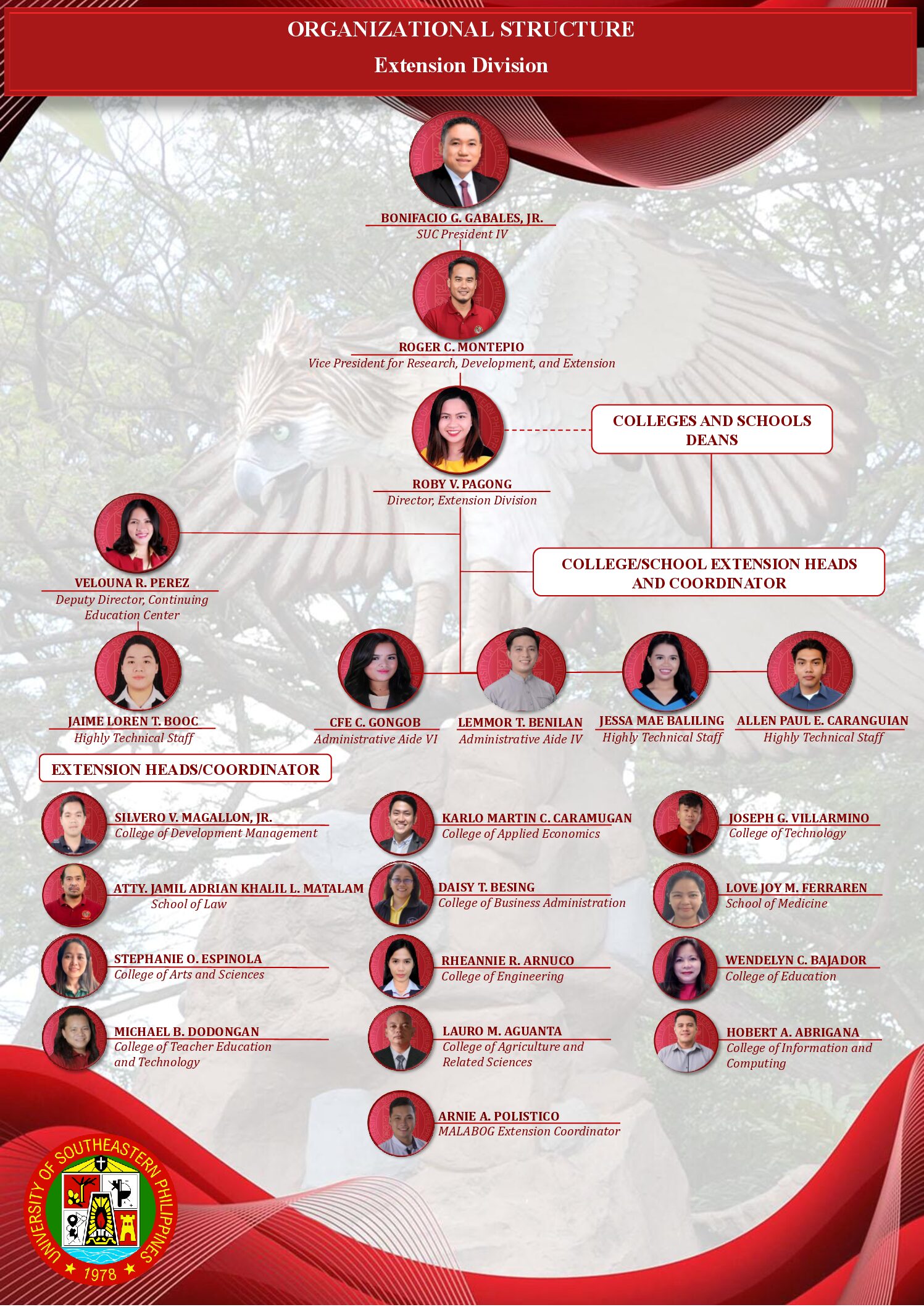
Organizational Structure
Services
Grounded on the mandate of the university in the Typology of higher education institutions (HEIs), the University of Southeastern Philippines develop programs and outreach activities that allow students, faculty, and staff to apply the new knowledge and technology they generate to help address specific social development problems, broadly defined in CM0 46, s. 2012. It is guided from the definition of communication and transferring knowledge and technology to specific sectors and target clientele to enable them to effectively improve production, community and/or institutions, and quality of life, at the same time enhance HEI’s academic and research programs (CMO 8, s. 2010).
Under CMO 8, s. 2010, an Integrated Extension Program shall include the following components:
-
- Training programs – non-degree and noncredit courses offered by a college or unit;
- Technical assistance and advisory services – to agencies, organizations, associations, and other groups;
- Communication/information services – communication and/or dissemination of knowledge and skills to particular client groups through the various means of dissemination such as person-to-person contact, radio, television, newspaper and other printed materials.
- Community outreach activities – extension activities conducted in areas outside the university/college, e.g., community-based social services, pilot projects, mobile clinic, etc.
- Technology transfer and utilization – the process of circulation, promoting and marketing research outputs or technologies to potential users.