
USeP CARS empowers Davao de Oro communities through a sustainable bamboo production initiative

USeP CARS empowers Davao de Oro communities through a sustainable bamboo production initiative

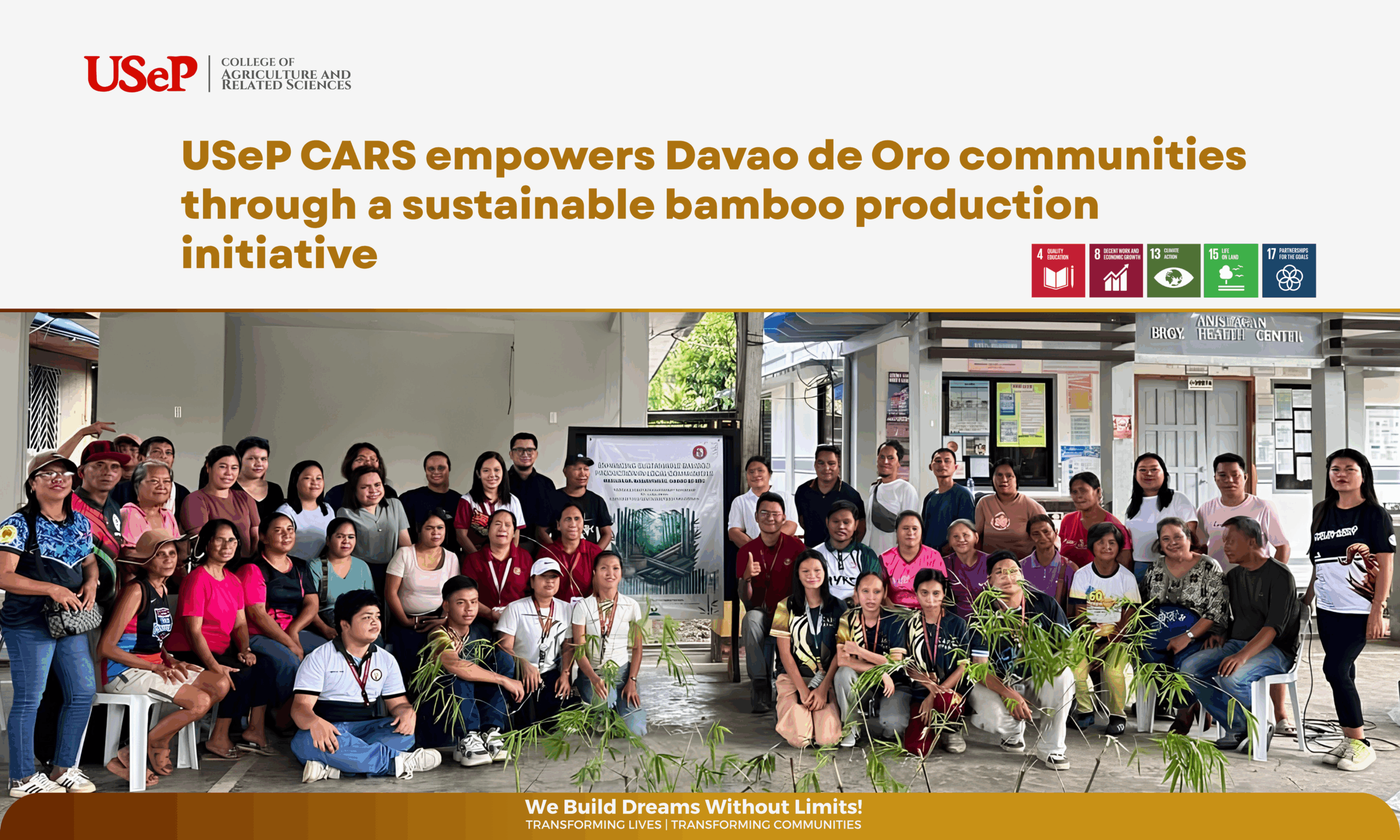
Strengthening communities through science, sustainability, and service, the USeP College of Agriculture and Related Sciences (CARS) successfully conducted an extension activity titled “Enhancing Sustainable Bamboo Production in Local Communities” on July 27, 2026, at the Barangay Hall of Barangay Anislagan, Nabunturan, Davao de Oro.

Implemented through the College’s flagship extension program, the “Program of Agriculture on Agroforestry Technology Integrated Management Approach for Sustainable Natural Resources” (PAg-ATIMAN), under Project 2: “Unlocking Sustainability with Agroforestry and Green Technology” (USWAG), this initiative brought together members of People’s Associations (PAs) and community organizations from the barangays of Anislagan and Cabacungan. The activity provided participants with practical knowledge on sustainable bamboo production, agroforestry technologies, and green innovations that support environmental conservation and create sustainable livelihood opportunities for rural communities.
The extension program was spearheaded by Dr. Nympha E. Branzuela, Dr. Rosalinda P. Tutor, and Forester Christopher V. Famor, with the support of College Extension Head Mr. Lauro Aguanta, in collaboration with the Barangays Anislagan, Barangay Cabacungan, Nabunturan, Davao de Oro, and Assumption College of Nabunturan, Inc. The partnership underscored the importance of bringing academic expertise beyond the classroom and directly into communities where science-based solutions can create lasting impact.
In addition to fostering community engagement, the activity functioned as a dynamic learning environment for students. Master of Science in Environmental and Resource Management (MSERM) students integrated the extension activity into their Graduate Seminar. Meanwhile, Bachelor of Science in Forestry students, who are undertaking their Off-Semester 2025–2026 On-the-Job Training (OJT) and Field Practicum, gained valuable hands-on experience in community extension, environmental education, and sustainable resource management. Through collaboration with faculty experts and local stakeholders, students applied theoretical concepts to practical solutions, thereby strengthening the University’s commitment to experiential and service-oriented learning.
Interactive discussions highlighted bamboo’s ecological and economic value, emphasizing its role in watershed protection, carbon sequestration, climate resilience, and rural enterprise development. Participants also exchanged local experiences and explored sustainable production techniques, propagation methods, and value-adding opportunities that could strengthen community-based bamboo industries while ensuring responsible stewardship of natural resources.
The initiative demonstrates USeP’s strong commitment to developing inclusive and science-based extension programs that empower communities through innovation, collaboration, and sustainable development. By combining instruction, research, and extension services, the University builds partnerships aimed at improving livelihoods while preserving the environment for future generations.
The activity significantly advanced several United Nations Sustainable Development Goals (SDGs), specifically SDG 4 (Quality Education) by promoting lifelong learning and building community capacity; SDG 8 (Decent Work and Economic Growth) by developing sustainable livelihoods; SDG 13 (Climate Action) by encouraging climate-resilient agroforestry practices; SDG 15 (Life on Land) through responsible forest management and ecosystem preservation; and SDG 17 (Partnerships for the Goals) by strengthening collaboration among the university, local government, academic institutions, and community organizations.

Beyond just an extension activity, this initiative illustrated how knowledge becomes more meaningful when shared with communities. As USeP continues to connect academic excellence with grassroots development, every bamboo plant, every skill transfer, and every partnership forged brings the University closer to its vision of creating empowered communities and a more sustainable future, one extension initiative at a time.

Leave a Reply

Your email address will not be published.