


UNIVERSITY OF SOUTHEASTERN PHILIPPINES
The University of Southeastern Philippines (USeP) is a regional state university established through Batas Pambansa Blg. 12, approved on December 15, 1978. The law established USeP in Region XI and provided for the integration of four state institutions: the Mindanao State University (MSU) – Davao, the University of the Philippines (UP) – Master of Management Program in Davao, the Davao School of Arts and Trades (DSAT), and the Davao National Regional Agricultural School (DNRAS). USeP became operational in 1979.
The University’s charter was subsequently amended through Batas Pambansa Blg. 87, approved on October 14, 1980. Among its amendments were provisions concerning the University’s degree-granting courses, the powers and appointment of the University President, and the transfer of the University of the Philippines branch in Region XI, the Davao School of Arts and Trades, the Mampising National Agricultural School, and the branches of Mindanao State University in Region XI, excluding the General Santos branch, to USeP together with their functions, appropriations, records, equipment, property, and personnel.
At present, USeP has four campuses, comprising the Obrero Campus in Davao City, which serves as the main campus; the Mintal Campus in Davao City; the Tagum-Mabini Campus, with units in Apokon, Tagum City and Mampising, Mabini, Davao de Oro; and the Malabog Extension Campus in Paquibato District, Davao City.
USeP offers graduate, post-baccalaureate, and undergraduate academic programs in a broad range of fields, including education, engineering, arts and sciences, economics, business, technology, information and computing, agriculture and forestry, development management, accountancy, law, and medicine. These programs respond to the evolving needs of learners, communities, industries, and the region.
Guided by its vision of becoming a premier research university that transforms communities in the ASEAN and beyond, USeP advances its mission through quality instruction, pioneering research and innovation, dynamic extension and community engagement, and effective resource management and leadership development.
Anchored on its core values of Collaboration, Accountability, Resilience, Excellence, and being Service Oriented, the University promotes inclusive and sustainable development, with a distinct emphasis on science, technology, agriculture, and innovation.
1. To provide programs of instruction and professional training primarily in the fields of science and technology, especially medicine, fisheries, engineering, and industrial fields.
2. To promote advanced studies, research and extension services, and progressive leadership in science, agriculture, forestry, fisheries, engineering and industrial fields, and other programs needed in the socio-economic development of Mindanao.
3. To develop courses of graduate level along the fields of specialization and to respond to the needs of the development workers in the academic community.
4. To provide non-formal education and undertake vigorous extension and research programs in food production, nutrition, health and sports development.
5. To offer scholarships and/or part-time job opportunities to deserving students from low-income families.
Through its flagship academic programs, USeP continues to play a vital role in advancing Mindanao’s socio-economic progress and shaping future-ready leaders committed to regional and national development.
Awards and Recognition
In 2024, USeP received the Philippine Quality Award (PQA) Level III – Recognition for Mastery in Quality Management, recognizing its established systems and practices for organizational performance and quality management.
USeP also received Level 1 Institutional Accreditation from the Accrediting Agency of Chartered Colleges and Universities in the Philippines (AACCUP) for the Obrero Campus in 2025. USeP was one of only four State Universities and Colleges granted institutional accreditation during the 38th AACCUP Annual National Conference.
The University made its debut in the QS World University Rankings: Asia 2025, ranking 169th in Southeast Asia and placing in the 901+ band in Asia. This recognition reflects USeP’s growing presence in international higher education, supported by its academic standards, research, innovation, and community engagement.
In the World University Rankings for Innovation (WURI) 2026, USeP ranked 74th for SDG- and ESG-Based Responses to Past and Present Global Challenges and 83rd for Inclusive Social Innovation for the Underserved. These recognitions highlight the University’s contributions to sustainable development, inclusive innovation, and education responsive to evolving societal needs.
USeP further strengthened its global sustainability standing in the 2026 Times Higher Education (THE) Sustainability Impact Ratings, advancing to the 1,001–1,500 global ranking band, from 1,501+ in 2025. In the UI GreenMetric World University Rankings 2025, USeP rose to 986th globally and 48th in the Philippines, reflecting its continuing work in sustainable campus development, education, and research.
For transparency and accountable governance, USeP was named FOI Champion in the State Universities and Colleges (SUCs) Category at the 2025 Freedom of Information (FOI) Awards, its third win after 2021 and 2024. Its FOI Officer, Mr. Robert C. Satorre, was likewise recognized as Best FOI Officer for the third time.
Program Accreditation and Level 4 SUC Status
Since the early 2000s, the University of Southeastern Philippines (USeP) has pursued program accreditation as an important component of its institutional quality assurance efforts. The University has continuously submitted its academic programs for evaluation by the Accrediting Agency of Chartered Colleges and Universities in the Philippines (AACCUP), strengthening its commitment to quality and continuous improvement.
The University’s pursuit of quality was further recognized through its State Universities and Colleges (SUC) Level IV status. In 2005, USeP achieved SUC Level IV status, a distinction formally recognized in 2007 by a tripartite body composed of the Commission on Higher Education (CHED), the Department of Budget and Management (DBM), and the Philippine Association of State Universities and Colleges (PASUC), Inc. This achievement marked a remarkable leap from Level II in 2001. Under the 2016 SUC Levelling Assessment, whose results were released by CHED in August 2018 through CHED Memorandum Order No. 12, series of 2018, USeP earned 35.65 equivalent points, qualifying it for Level IV status. USeP was identified as the only SUC in Region XI and was among 20 out of 111 SUCs nationwide granted Level IV status.
The Level IV classification recognizes institutional performance across key results areas, including Quality and Relevance of Instruction, Research Capability and Output, Services to the Community, and Management of Resources. USeP’s standing was supported by its performance in areas such as faculty qualifications, licensure examination results, accredited programs, research activities and outputs, community partnerships, externally funded research, innovation, and faculty and staff development.
USeP has continued to strengthen its academic quality assurance system through sustained program accreditation. Its accreditation efforts have received national recognition. In 2016, AACCUP recognized USeP as sixth among state universities and colleges in the country with the most number of accredited programs. These continuing accreditation efforts also paved the way for broader institutional quality assurance initiatives. USeP attained Level I Institutional Accreditation for its Obrero Campus, establishing an important foundation for the University’s continuing pursuit of institutional quality and excellence.
Through sustained program accreditation and institutional quality assurance, USeP continues to strengthen its academic programs, research, community engagement, and university management in pursuit of higher standards of public higher education.
Three-Year Institutional Development Plan 2025-2027
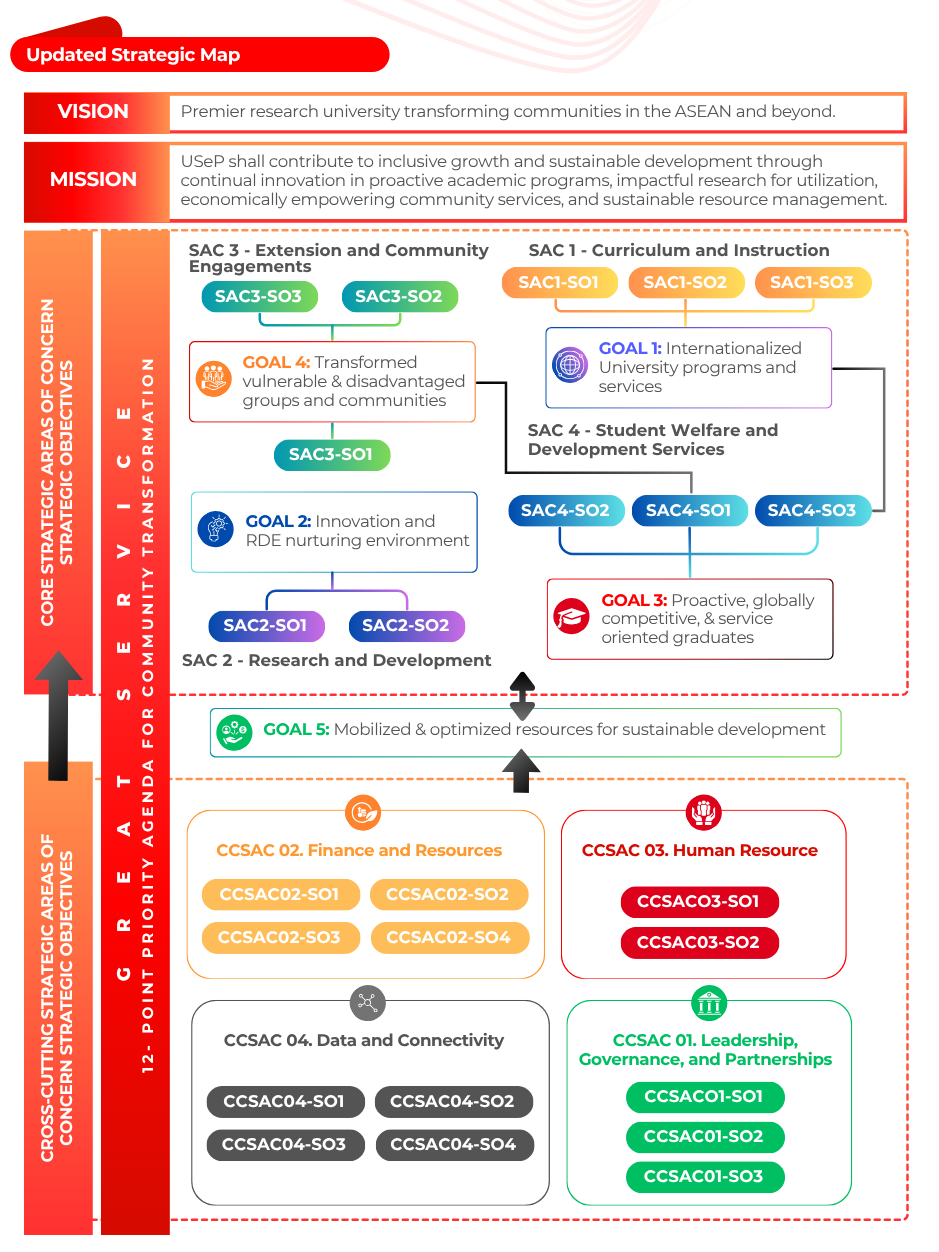
The University’s Institutional Development Plan 2025-2027 includes Core Strategic Areas of Concern (SAC) in the areas of Curriculum and Instruction (SAC 1), Research and Development (SAC 2), Extension and Community Engagements (SAC 3), and Student Welfare and Development Services (SAC 4). Four Cross-Cutting SACs are incorporated into the strategic map, namely: CCSAC 1– Leadership, Governance, and Partnerships; CCSAC 2– Finance and Resources; CCSAC 3– Human Resource; and CCSAC 4– Data and Connectivity. These SACs and CCSACs are key drivers in achieving the following goals: (1) Internationalized University programs and services, (2) Innovation and RDE nurturing environment, (3) Proactive, globally competitive, and service-oriented graduates, (4) Transformed vulnerable and disadvantaged groups and communities, and (5) Mobilized and optimized resources for sustainable development.
All initiatives also aligned with the University’s 12-point priority agenda. Further, the attainment of the Strategic Objectives in the Core and Crosscutting SACs contributes to the realization of our vision. This also propels the University to fulfill its mission.
Specialized Tertiary Education for Persons Deprived of Liberty
In 2017, USeP, in partnership with key stakeholders including the Social Entrepreneurship, Technology, and Business Institute (SETBI), launched the Prison Rehabilitation and College Education Behind Bars (CEBB) Program, an innovative initiative that brings higher education opportunities to persons deprived of liberty.
Through CEBB, qualified persons deprived of liberty at the Davao City Jail are given access to higher education and the opportunity to pursue a college degree. The program integrates education into the rehabilitation process, providing learners with opportunities to develop their knowledge, skills, and capacities while preparing for productive participation in society.
The program has gained recognition for its contribution to rehabilitation, education, and community development. CEBB was recognized by the National Economic and Development Authority (now Department of Economy, Planning and Development) among the Outstanding Government Programs/Projects, highlighting its contribution to public service and development.
The program’s impact also gained international recognition. In 2023, CEBB was named Second Runner-Up in the Internationalization Champions of Nation Building and Sustainability (ICONS) under the Global Citizenship Award – SUC/LUC Category, conferred by the Commission on Higher Education – International Affairs Service (CHED-IAS).
Through CEBB, USeP extends its commitment to inclusive and accessible higher education to communities and individuals who face significant barriers to pursuing a college education. The program demonstrates how education can serve as an integral component of rehabilitation, personal development, and social reintegration, while contributing to the University’s broader commitment to responsive and inclusive public service.
Units Managing the Innovations of the University
Between 2015 and 2016, USeP established several institutional units to strengthen the University’s capacity for innovation, intellectual property management, and technology transfer. Among these was the Knowledge and Technology Transfer Division (KTTD), which provides an institutional link among instruction, research, innovation, and extension. Its units include the Innovation and Technology Support Office (ITSO), now the Intellectual Property Management Unit (IPMU); the Incubation Unit, now the Technology Business Incubation Unit (TBIU); and the Technology Transfer Unit. KTTD also oversees the DigiHub FabLab Davao and the Metals and Engineering Innovation Center (MEIC).
The institutional protection and management of intellectual property generated from the University’s research and development activities were further strengthened through the establishment of the USeP IPMU (ITSO), in partnership with the Intellectual Property Office of the Philippines (IPOPHL) and the Department of Science and Technology (DOST). As an ITSO, the unit supports intellectual property protection and technology transfer by providing patent information and search services and assisting researchers and innovators in navigating intellectual property processes. It also serves as a local access point for IPOPHL-related intellectual property services and information.
USeP’s sustained efforts in intellectual property management and technology transfer have continued to gain national recognition. In 2026, USeP, through KTTD, received both the Palladium Award and Platinum Award from the Intellectual Property Office of the Philippines (IPOPHL) during the ITSO Presidents’ Summit and General Assembly. These distinctions recognize the University’s continuing work in intellectual property management, innovation, and technology transfer and further strengthen USeP’s position as an institution committed to translating research and innovation into practical applications and societal value.
Performance in Licensure Examinations
For more than a decade, the University has consistently produced graduates who excel in national licensure examinations. From 2010 to 2026, USeP graduates placed among the Top 10 in various professional licensure examinations, which reflects the quality of the University’s academic programs and USeP’s commitment to preparing graduates for professional practice.
USeP has recorded topnotchers in Teacher Education, Geodetic Engineering, Agricultural and Biosystems Engineering, Civil Engineering, Mining Engineering, Electronics Engineering, Electronics Technician, Electrical Engineering, Mechanical Engineering, Sanitary Engineering, Master Plumbing, Accountancy, Geology, Forestry, Agriculture, and Environmental Planning. Several graduates have earned Top 1 honors in their respective licensure examinations, while many others placed within Top 2 to Top 10. These rankings demonstrate the University’s capacity to develop highly competent and nationally competitive professionals across diverse fields.
Furthermore, the University has also received recognition as a Top Performing School in various licensure examinations and has recorded 100% passing rates in several examinations. These achievements affirm USeP’s continuing commitment to quality instruction, competent faculty, rigorous academic preparation, and professional excellence.
The sustained performance of USeP graduates in national licensure examinations contributes to the University’s reputation for producing professionals who meet national standards and contribute their expertise to the development of Mindanao and the country.
Accessible Education
The University implements an Equivalency Program that provides opportunities for undergraduates, working professionals, and government employees to pursue and complete academic degrees by recognizing relevant prior learning, work experience, and competencies acquired outside the traditional classroom setting. Central to this initiative is the Expanded Tertiary Education Equivalency and Accreditation Program (ETEEAP), an assessment framework that formally recognizes knowledge, skills, competencies, and prior learning acquired through non-formal and informal education and relevant work experiences.
Through equivalency and accreditation mechanisms, USeP provides alternative pathways for qualified learners who may have gained substantial knowledge and competencies through professional practice, industry experience, training, and other forms of learning. These mechanisms enable learners to have relevant prior learning assessed and credited toward appropriate academic requirements, subject to applicable higher education policies and institutional standards.
To respond to changing workforce and industry requirements while maintaining academic quality, USeP continues to develop and offer industry-responsive academic programs that address emerging professional and community needs. The University also employs flexible approaches to teaching and learning that accommodate learners with diverse circumstances, backgrounds, and educational needs.
Complementing these initiatives, the University utilizes the USeP Virtual Environment to support online and technology-enabled learning. The platform provides learners and faculty with access to digital course materials, learning activities, assessments, communication tools, and other academic resources, extending learning opportunities beyond the conventional classroom. These initiatives form part of USeP’s continuing efforts to make higher education accessible, flexible, responsive, and relevant.
Career Advancement and Support for Alumni
The University not only provides quality education but also supports students and graduates in pursuing employment and career opportunities that match their qualifications, competencies, and professional aspirations. This commitment is strengthened through the Public Employment Service Office (PESO), established in partnership with the Department of Labor and Employment (DOLE). PESO facilitates access to employment information, career opportunities, job matching, recruitment activities, and other employment-related services for USeP students and graduates.
Further strengthening the University’s career development initiatives, USeP inaugurated the Career and Alumni Center in 2017. The Center serves as a link between students, graduates, employers, professional organizations, and industry partners. It provides career-related services and activities that assist students and alumni in exploring employment opportunities, developing career competencies, and establishing professional connections.
The University also continues to strengthen its relationship with its alumni through initiatives that provide spaces for alumni engagement and institutional activities. At the USeP Tagum-Mabini Campus, Tagum Unit, the Balay Alumni was constructed through the support of the USeP Alumni Federation, which provided funding for the project, while the University contributed the site as its counterpart. The facility serves as a venue for alumni activities, meetings, and engagements, further strengthening the connection between the University and its graduates.
Faculty Development Programs
The University takes pride in its distinguished faculty, who have cultivated expertise across a wide range of disciplines. Many of them have actively contributed to the global academic community by presenting their research in international forums and publishing their papers in peer-reviewed international journals.
Several faculty members have also earned citations from international organizations and secured highly prestigious scholarship grants, including the Fulbright Program, the Australian Leadership Awards, and the Philippines–Australia Human Resource and Organizational Development Facility. These achievements underscore the University’s commitment to academic excellence and its growing presence in the international scholarly landscape.
Research, Development, and Extension Programs
At USeP, research is not only produced but transformed into practical knowledge and technology that benefit communities. The University pursues research initiatives that respond to the needs of both the region and the nation. Its Research, Development and Extension (RDE) agenda encompasses key areas such as:
- Agriculture, Aquatic, and Agro-Forestry
- Business and Trade
- Social Sciences and Education
- Engineering and Technology
- Environment and Natural Resources
- Health and Wellness
- Peace and Security
USeP places strong emphasis on the dissemination and utilization of research findings, ensuring that outcomes are integrated into extension activities for greater societal impact.
For more than a decade now, USeP has served as the base agency of the Southern Mindanao Agriculture, Aquatic and Resources Research and Development Consortium (SMAARRDEC), a 33-member consortium composed of line agencies and research institutions engaged in agriculture and related fields. The University also hosts the Affiliated Renewable Energy Center, the extension arm of the country’s Department of Energy, which promotes and commercializes renewable energy technologies in Southern Mindanao.
International Linkages
The University continues to expand its global engagement through strategic international partnerships that support academic collaboration, research and innovation, faculty and student mobility, knowledge exchange, and cross-cultural learning. Through its network of partner institutions, organizations, and international consortia, USeP creates opportunities for collaborative research, joint academic initiatives, capacity-building activities, professional development, and international exposure for its students, faculty, and staff.
These international engagements strengthen the University’s ability to share knowledge and expertise across borders, establish collaborative solutions to common challenges, and provide learning experiences that broaden perspectives and enhance global competencies. They also contribute to USeP’s vision of becoming a premier research university transforming communities in the ASEAN and beyond.
As of the second quarter of 2026, USeP has established international linkages across Asia, Oceania, Africa, and Europe, together with participation in international consortia and research and extension networks. The following are the University’s existing international linkages:
- Philippine CJC Association for Friendship and Education Promotion (AFEP)
- Nanjing Normal University of Special Education (NNUSE)
- Southwest Forestry University
- Lingnan University (LU)
- Chandigarh University (CU)
- Kalasalingam Academy of Research and Education
- Pasundan University
- Universitas Negeri Yogyakarta (UNY)
- College Impact Japan
- Mindanao-Japan Science and Technology Platform (MJ-STEP)
- SEAMEO Regional Centre for Special Educational Needs (SEAMEO SEN)
- Universiti Malaysia Perlis
- Universiti Teknologi Malaysia
- Academy of Entrepreneurs (AE)
- Madonna University
- University of Passau
- Institut Polytechnique des Sciences Avancées (IPSA)
- Asia Technological University Network
- University Mobility in Asia and the Pacific
- Magic 7+ Consortium
- Global Development Learning Network
- United Nations Office for Project Services (UNOPS)
- Australian Centre for International Agricultural Research (ACIAR)
- Universiti Teknologi PETRONAS
Through these strategic global partnerships, the University continues to expand opportunities for international education, interdisciplinary research, knowledge exchange, and sustainable development, reinforcing its commitment to producing globally competitive graduates and creating meaningful impact in local and international communities.